Transpose and Permutation Matrices - Chapter 2 (2.7)
📅Published on July 04, 2022 ☕Keywords: Matrix, SympyNOTES:
- The columns of $A^T$ are the rows of $A$; $(A^T)_{ij} = A_{ji}$.
-
Proof of $(Ax)^T = x^TA^T$, where $x$ is a column vector:$Ax = \left( \begin{matrix} \mathbf{a_1} \, \mathbf{a_2} \, \cdots \, \mathbf{a_n} \end{matrix} \right) \left( \begin{matrix} x_1 \\ x_2 \\ \vdots \\ x_n \end{matrix} \right) = \left( x_1 \mathbf{a_1} + x_2 \mathbf{a_2} + \, \cdots + \, x_n \mathbf{a_n} \right) = \left( \begin{matrix} x_1 a_{11} + x_2 a_{12} + x_3 a_{13} + \cdots + x_n a_{1n} \\ x_1 a_{21} + x_2 a_{22} + x_3 a_{23} + \cdots + x_n a_{2n} \\ \vdots \\ x_1 a_{n1} + x_2 a_{n2} + x_3 a_{n3} + \cdots + x_n a_{nn} \end{matrix} \right)_{n*1} $Then $(Ax)^T$ should be $ \phantom{ \begin{matrix} 1 \\ 1 \end{matrix} } \left( \begin{matrix} x_1 a_{11} + x_2 a_{12} + x_3 a_{13} + \cdots + x_n a_{1n} \quad x_1 a_{21} + x_2 a_{22} + x_3 a_{23} + \cdots + x_n a_{2n} \quad \cdots \quad x_1 a_{n1} + x_2 a_{n2} + x_3 a_{n3} + \cdots + x_n a_{nn} \end{matrix} \right)_{1*n} $, which equals to $ \left( \begin{matrix} x_1 \, x_2 \, \cdots \, x_n \end{matrix} \right) \left( \begin{matrix} a_{11} \, a_{21} \, a_{31} \, \cdots \, a_{n1} \\ a_{12} \, a_{22} \, a_{32} \, \cdots \, a_{n2} \\ \vdots \\ a_{1n} \, a_{2n} \, a_{3n} \, \cdots \, a_{nn} \end{matrix} \right) = x^TA^T $Therefore, $(Ax)^T = x^TA^T$$Ax$ combines the columns of $A$ while $x^TA^T$ combines the rows of $A^T$.
-
Proof of $(AB)^T = B^TA^T$:$AB = A \left( \begin{matrix} \mathbf{b_1} \; \mathbf{b_2} \; \cdots \; \mathbf{b_n} \end{matrix} \right) = \left( \begin{matrix} A\mathbf{b_1} \; A\mathbf{b_2} \; \cdots \; A \mathbf{b_n} \end{matrix} \right) $Then $(AB)^T$ should be $ \left( \begin{matrix} (A\mathbf{b_1})^T \\ (A\mathbf{b_2})^T \\ \vdots \\ (A \mathbf{b_n})^T \end{matrix} \right) $, which equals to $ \left( \begin{matrix} \mathbf{b_1}^T A^T \\ \mathbf{b_2}^T A^T \\ \vdots \\ \mathbf{b_n}^T A^T \end{matrix} \right) $, according to the argument we just proved above.And, $ \left( \begin{matrix} \mathbf{b_1}^T A^T \\ \mathbf{b_2}^T A^T \\ \vdots \\ \mathbf{b_n}^T A^T \end{matrix} \right) = \left( \begin{matrix} \mathbf{b_1}^T \\ \mathbf{b_2}^T \\ \vdots \\ \mathbf{b_n}^T \end{matrix} \right) A^T = B^TA^T $, according to Matrix Operations Chapter 2 (2.4)Therefore, we have proved $(AB)^T = B^TA^T$.
- $ (ABC)^T = C^TB^TA^T $; If $A = LDU$, then $A^T = U^TD^TL^T$.
- $(A+ B)^T = A^T + B^T$
- $ (A^{-1})^T = (A^T)^{-1} $; $A^T$ is invertible exactly when $A$ is invertible.
- $(Ax)^Ty = x^T(A^Ty)$: Inner product of $Ax$ with $y =$ Inner product of $x$ with $A^Ty$.
- Given a symmetric matrix $S$, the inverse of $S$ is also symmetric. $$ (S^{-1})^T = (S^T)^{-1} = S^{-1} $$
- Choose any matrix $A$, probably rectangular. $S = A^TA$ or $S' = AA^T$ is automatically a square symmetric matrix.
- The $LU$ elimination of a symmetric matrix $S$ is symmetric: $ S = LDL^T$.
- A permutation matrix $P$ has the rows of the identity matrix $I$ in any order. There are $n!$ permutation matrices of order $n$.
- $P^{-1}$ is also a permutation matrix. A single row exchange is its own inverse.
- $P^{-1}$ is always the same as $P^T$. When we multiply $PP^T$, the "1" in the first row of $P$ hits the "1" in the first column of $P^T$. It misses the ones in all the other columns. So $PP^T=I$.
- If $A$ is invertible, a permutation $P$ will put its rows in the right order to factor $PA=LU$ There must be a full set of pivots after row exchanges for $A$ to be invertible.
LAB:
1) 🐥 experiments for $(AB)^T = B^TA^T$.
          from sympy.interactive.printing import init_printing
          init_printing(use_unicode=True)
          from sympy.matrices import Matrix
          from sympy import randMatrix, pprint, eye
          from sympy import symbols, sqrt, Rational, acos

          def compare():
              for i in range(3):
                  A = randMatrix(i + 2, 3, -10, 10) # make random matrix with dimension (i+2)*3
                  B = randMatrix(3, i + 2, -10, 9)
                  E = (A*B).T
                  F = B.T*A.T
                  result = (E == F)
                  pprint( [A, B, E, result]  )
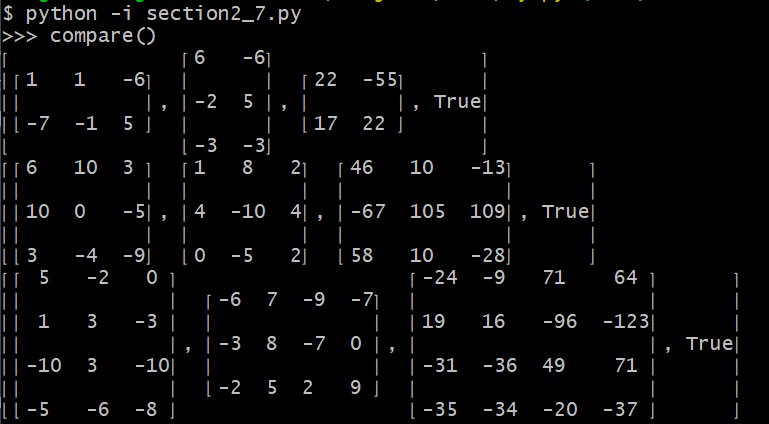
Our example shows that $(AB)^T = B^TA^T$.
2) 🐥 experiments for $A^TA $ or $AA^T$.
A = Matrix([[1, 2], [2, 5], [-3, 2]]);
A*A.T # symmetric
$$ \left( \begin{matrix} 5 & 12 & 1 \\ 12 & 29 & 4 \\ 1 & 4 & 13 \end{matrix} \right) $$
A.T*A # also symmetric
$$ \left( \begin{matrix} 14 & 6 \\ 6 & 33 \end{matrix} \right) $$
3) 🐥 matrix row exchange function $P^{-1} = P^T$
          def row_switch(A, i, j):    # define a row switch function
              row_i = A[i, :]         # matrix slicing
              row_j = A[j, :]
              A[i, :] = row_j
              A[j, :] = row_i
              return A                # we get the matrix as row i and j are switched

          A = row_switch(eye(3), 0, 1)
          A = row_switch(A, 0, 2)
A; A.inv(); A.T
$$ \left( \begin{matrix} 0 & 0 & 1 \\ 1 & 0 & 0 \\ 0 & 1 & 0 \end{matrix} \right),
\left( \begin{matrix} 0 & 1 & 0 \\ 0 & 0 & 1 \\ 1 & 0 & 0 \end{matrix} \right),
\left( \begin{matrix} 0 & 1 & 0 \\ 0 & 0 & 1 \\ 1 & 0 & 0 \end{matrix} \right) $$
A.inv() == A.T
$$ True $$